
The way to sound natural is to explain what you are trying to find out. If every branch has a clear job in answering the client's question, you can present it in ordinary language. If the branches are labels you memorised, changing the wording will only disguise the problem briefly.
I would practise the reasoning before polishing the delivery. You should be able to defend why a branch belongs, why you want to start there and what finding would make you move on.
Take a moment to choose your approach
Pausing to draw a framework can feel artificial when you are new to cases. The pause earns its place when it helps you explain how you will answer the client's question.
The pause is useful when you use it to think. A brief “Let me organise the main questions” gives you time to choose a coherent approach and makes the answer easier to follow. The awkwardness comes when the pause produces a generic list you cannot connect to the problem.
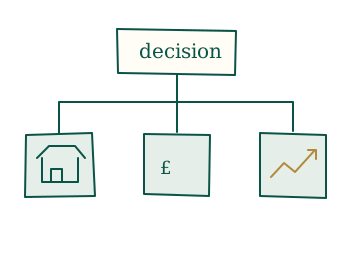
Write the decision at the top of the page. Then write the few questions whose answers would determine that decision. You can add detail as the case develops.
Build the structure around a real choice
Consider a hotel deciding whether to accept an airline's annual crew contract. The airline wants 20 rooms every night at £80 per room. The hotel wants to increase annual operating profit without harming its existing business.
A generic opening would promise to examine the market, customers, competitors and company. The interviewer still has to guess how those topics will resolve the contract decision.
A useful approach asks three linked questions. What contribution does the contract add? What business would it displace? Can the hotel serve the crews reliably under the contract terms?
Under the first question, investigate the room rate, occupied nights, incremental servicing costs and extra requirements. Under the second, look at occupancy by date and the contribution from guests who would otherwise book. Under the third, examine arrival patterns, room availability, service obligations and penalties.
Define the problem, prioritise its drivers and adapt as evidence arrives. In the hotel example, each branch earns its place because it can change the recommendation.
Quick Structuring Drill
A family printing firm has been offered a weekly contract to print a regional newspaper. The owners want higher annual profit without losing existing customers.
Which test in the contract decision does each question help answer?
Present the logic, then your starting point
You could say:
I'd compare the contribution from the airline contract with the contribution we might lose from other guests. I'd also check whether we can meet the service requirements, particularly when the hotel is busy. I'd start with occupancy by date because filling otherwise empty rooms has very different economics from replacing full-price bookings.
That explanation has a point of view without pretending to know the answer. It names a promising first investigation and explains why it matters.
Use concise notes rather than a written speech. If your partner interrupts after the first sentence, you should still know what you are trying to establish. A structure that only works when recited uninterrupted is too dependent on the script.
Let the numbers change the conversation
Suppose incremental servicing costs are £30 per occupied room-night. The contract therefore contributes £50 per room-night, or 20 × 365 × £50 = £365,000 annually before any additional fixed costs.
Now learn that on 100 nights the hotel would otherwise sell those 20 rooms for £180, with the same £30 servicing cost. Each displaced room-night sacrifices £150 of contribution. The lost contribution is 20 × 100 × £150 = £300,000.
The contract adds only £65,000 before extra fixed costs and contract risks. If dedicated transport costs another £80,000 annually, the proposal reduces operating profit by £15,000 under these assumptions.
Your next question should concern the decision: can the hotel exclude peak dates, renegotiate the rate or change the transport arrangement? A broad investigation of the airline industry's growth is now unlikely to be the best use of time.
Quick Case Math Drill
A commercial printer could take a year-long contract printing a weekly retail catalogue. The work would use press time currently sold to urgent local jobs.
- Contract contribution
- £240,000 a year before displacement
- Urgent work displaced
- 600 press-hours a year
- Urgent work contribution
- £300 per press-hour
What annual contribution does the contract add after displaced urgent work, before extra fixed costs?
Know when you have investigated enough
A branch has done its job when its answer is clear enough to guide the next decision. You do not need to exhaust every possible sub-question before moving on.
In the hotel case, if the client confirms transport is unavoidable and the rate cannot change, the current proposal is unattractive on annual profit. You can explain that conclusion and identify what would make an alternative viable. Continuing to ask about minor housekeeping costs may add detail without changing the answer.
Use a short transition: “At the quoted terms, the contract reduces profit by £15,000. I'd now test whether excluding peak nights changes the economics.” This keeps your partner oriented and prevents the case becoming a sequence of disconnected analyses.
Stay conversational when challenged
If the interviewer asks why you omitted competitors, answer the substance. “Competitors matter if they affect the rate we can negotiate or the demand we expect to displace. I'd bring them into those questions.” You do not need a separate competition heading to show you understand competition.
If the interviewer reveals a new objective, revise your structure. A hotel trying to stabilise cash flow may accept lower expected annual profit for more dependable revenue. You would then examine seasonality, payment timing and the reliability of the airline's commitment, while making the profit trade-off explicit.
Adapting is part of structured thinking. Explain what changed and why your next question changes with it.
Practise one prompt with three different objectives
Take the hotel prompt and change the objective from profit growth to steadier occupancy, then to reducing staff scheduling volatility. Build a short approach for each and explain the difference aloud.
Ask a partner to challenge one branch: “What would we do differently if we knew the answer?” If you cannot answer, sharpen the branch or remove it. Then practise presenting the approach in less time while preserving the logic.
The framework library gives you business relationships to draw on. Use those relationships to construct an answer to the actual problem, and let the delivery sound like someone explaining a decision they understand.
Frequently asked questions
Building a case-specific structure
How do I sound structured without sounding like I memorised a framework?
Explain what you are trying to find out. If every branch has a clear job in answering the client's question, you can present it in ordinary language. Practise the reasoning before polishing the delivery, so you can defend why each branch belongs and why you would start there.
Will rephrasing a standard framework make it sound less rehearsed?
Only briefly. If the branches are memorised labels, new wording disguises the problem without solving it. A generic opening covering the market, customers, competitors and company still leaves the interviewer guessing how those topics resolve the client's decision. Build the branches around the actual choice instead.
Is it awkward to pause before presenting my structure?
Not if you use the pause to think. A brief 'Let me organise the main questions' gives you time to choose a coherent approach and makes your answer easier to follow. The pause earns its place when it helps you explain how you will answer the client's question.
What does a structure built around a real choice look like?
In the article's example, a hotel is deciding whether to accept an airline's contract for 20 rooms every night at £80 per room. A useful approach compares the contract's contribution with the contribution lost from other guests, and checks whether the hotel can meet service requirements when it is busy.
Do I need to say where I would start?
Yes, and give the reason. In the hotel case, you might start with occupancy by date, because filling otherwise empty rooms has very different economics from replacing full-price bookings. Stating a starting point shows a point of view without pretending you already know the answer.
Using evidence as the case unfolds
How should the numbers change my approach mid-case?
Let them redirect the conversation rather than simply confirm your plan. With £30 incremental servicing costs, the airline contract contributes £50 per room-night, or £365,000 a year before extra fixed costs. But on nights when those rooms would otherwise sell for £180, each displaced room-night sacrifices £150 of contribution.
How do I know when I have investigated a branch enough?
A branch has done its job when its answer is clear enough to guide the next decision. You do not need to exhaust every possible sub-question. Once a finding settles what the branch was meant to answer, move to the next question that could still change the recommendation.
Can I reach a conclusion before covering every branch?
Yes, if the evidence supports it. In the hotel case, once the client confirms transport is unavoidable and the rate cannot change, the current proposal is unattractive on annual profit. Explain that conclusion, then identify what would make an alternative work rather than continuing to analyse a settled question.
Handling challenges and practising
What should I say if the interviewer asks why I left out competitors?
Answer the substance rather than defending a missing heading. For example: 'Competitors matter if they affect the rate we can negotiate or the demand we expect to displace. I'd bring them into those questions.' That shows you understand where competition affects the decision without needing a separate branch.
What if the interviewer reveals a new objective partway through?
Revise your structure to fit it. A hotel trying to stabilise cash flow may need a different approach from one maximising annual operating profit, so the branches that mattered before may no longer be the right ones. Adjusting openly shows you are reasoning about the client's goal rather than following a template.
How can I practise building structures that are genuinely case-specific?
Take one prompt and change the objective. With the hotel case, build short approaches for profit growth, steadier occupancy and reducing staff scheduling volatility, then explain the differences aloud. If your three structures look the same, the branches are not yet doing work for the specific question.
How do I test whether a branch deserves a place in my structure?
Ask yourself, or have a partner ask, 'What would we do differently if we knew the answer?' If you cannot say, sharpen the branch or remove it. A branch that cannot change the recommendation adds length without helping you answer the client's question.